

Robotic palletizers can’t be avoided in the current scenario for manufacturing and logistics. Those companies targeting greater productivity incorporate palletizing robots for their seamless operations. These robots ensure harmonious results that ensure workplace safety and security. This form of palletizing automation also improves consistency in end-of-line operations and supports faster throughput without compromising safety.
Robots are built in such a manner that they are able to rapidly stack, organize, and streamline products onto pallets efficiently. This makes robots palletizing a practical solution for operations that demand both speed and consistency.
These robots provide huge relief to workers by lowering the physical pressure placed on them while streamlining the operations. Businesses make better decisions when they truly understand the primary elements of a robotic palletizer while investing in automation and working with the accurate robotic palletizer manufacturer.
Why do Components of Robotic Palletizers Matter
Every component of a palletizing robot contributes to the smooth operation of the overall palletizing system. When these components are carefully developed and installed, robotic palletizers can provide flawless performance in less time, assisting in meeting and adapting to production demands. Poor quality can influence performance and increase maintenance charges primarily.
Key Components of a Robotic Palletizer
These components work together to ensure palletizing machines perform reliably in demanding industrial environments.
Robotic Arm
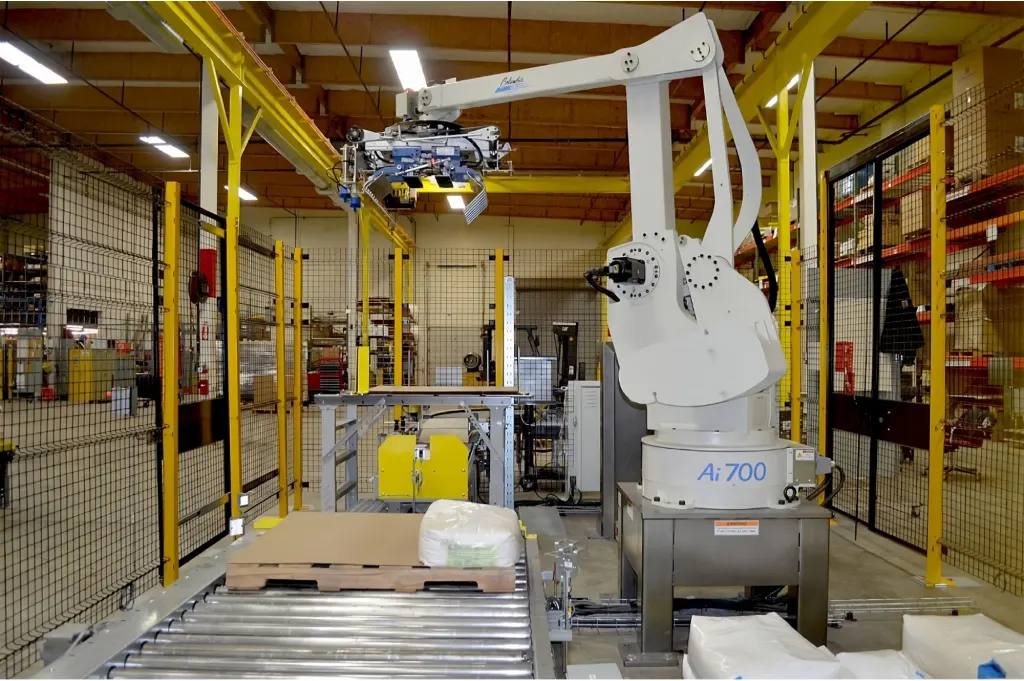
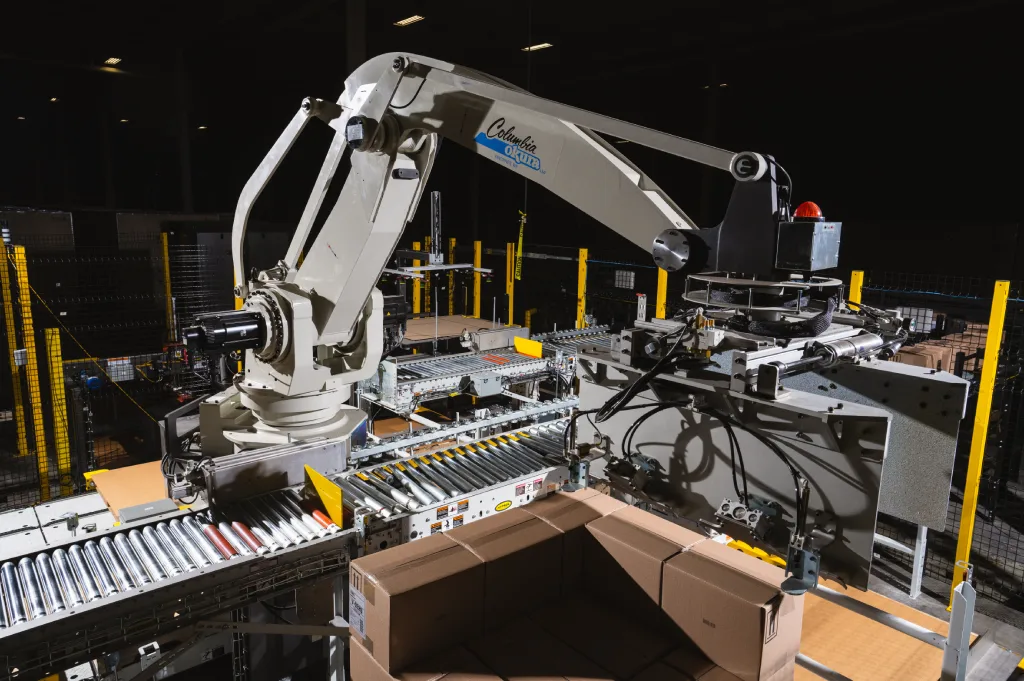
The robotic arm is the nucleus of any robotic palletizer. It offers the scope of motion, speed, and payload capacity needed to lift products and stack them correctly onto the pallets. Based on the usage, robotic arms might feature four, five, or six axes, helping in adaptable movement and accurate placement.
A palletizing robot consisting of exceptional quality ensures consistent stacking patterns and less product damage and also helps in a variety of load adaptations.
End-of-Arm Tooling (EOAT) or End Effector
End-of-arm tooling, also known as EOAT, is known as the attachment detected at the robotic arm’s end that physically supports or holds the product.
EOAT can be tailored depending upon its product shape, weight, and material, consisting of vacuum grippers, mechanical clamps, or hybrid designs.
EOAT in robotic palletizing is critical for retaining consistency, particularly when dealing with delicate, irregular, and varied pack items.
Conveyor System
The conveyor system supplies products to the robotic palletizer at regular and controlled method. Conveyors help to align products for accurate pickup and assist in synchronizing product flow with the palletizing robot cycle time.
An effective conveyor system assures even transitions, helps with high-speed palletizing operation, and avoids bottle necks.
Pallet Dispenser
A pallet dispenser on its own provides empty pallets to the palletizing robot. This element removes manual pallet handling and ensures continuous functioning. Pallet dispensers are specifically essential and work best in high-volume environments where downtime must be reduced. Although it is not needed at every palletizer setup, a pallet dispenser majorly enhances productivity in fully automated systems. This is one of the reasons modern palletizing machines are preferred for high-volume operations.
Control System
The control system serves as the brain for the robotic palletizer. It coordinates robot movement, pallet patterns, conveyor timing, and system component communication.
It also helps operators monitor and optimize the full palletizing system for speed, accuracy, and repeatability. Operators are provided with freedom in present-day control systems to modify pallet patterns, monitor system performance, and uniformly incorporate the palletizer with different production tools. To continue the smooth functioning of operations in an effective manner and incorporate varying requirements, intuitive interfaces and reliable programming are vital.
Safety Features
It is important that each robotic palletizer comprises these safety features, like guarding, fences, light curtains, emergency stop buttons, and safety-rated sensors. These components assure workers’ safety and help palletizing robots to operate in an effective manner in an industrial setting. By following established rules, it helps in uniform and dependable operation and ensures workers’ protection while working on the job.
Benefits of a Well-Designed Robotic Palletizer
A robotic palletizer comprising supreme quality offers several benefits like reliable performance, reduction in manpower reliability, enhances how products are handled, and enhances overall operational safety and measures. In high-output facilities, palletizing automation also supports consistent load quality while reducing manual intervention.
A properly designed system can further develop along with the business, making it easier to handle new products and varying production requirements without the requirement for major changes.
Industries That Rely on These Systems
The application of robotic palletizers and advanced palletizing machines is increasingly widespread in food and beverage, pharmaceuticals, logistics, consumer goods, building materials, and manufacturing. Each of these sectors depends on palletizer systems that are reliable to handle and manage varying product weights, sizes, and types of packaging with ease. As production lines scale, robot palletizing becomes a key factor in meeting volume targets without compromising safety.
Why Work with the Right Robotic Palletizer Manufacturer?
It is very important that the appropriate robotic palletizer manufacturers are chosen, as it decides that every component, including the robotic arm and control system, gets chosen accurately, seamlessly included, and receives complete support. A reliable manufacturer ensures that the entire palletizing automation setup is engineered for long-term uptime and smooth integration.
Manufacturers having experience of several years can detect application issues and offer solutions that perfectly strike a balance amongst performance, reliability, and long-term value.
Working with a suitable partner additionally provides the benefit of modifications, technical support, and future system updates.
Conclusion
A robotic palletizer acts as more than only a single piece of equipment; it’s a complete integrated robot palletizing solution built with precisely tailored elements. When every component works together efficiently, the complete palletizing system delivers stable performance and reduced downtime. Each single part, from the robotic arm and end-of-arm tooling to conveyors, control systems, and safety features, each small part of the palletizer plays an essential role in providing efficient and dependable palletizing. Companies can take improved decisions related to automation and thoroughly detect the advantages of robotic palletizing by simply learning the process and function of elements.
FAQs
1. What are the main components of a robotic palletizer?
The most significant parts of the system are a system controller, pallet dispenser, and robotic arm with end-of-arm tooling with safety features also in addition.
2. What does the robotic arm do in a palletizing robot?
The robotic arm performs essentially as required; it lifts and positions items with precision.
3. Why is end-of-arm tooling important in robotic palletizing?
Once the right tooling, i.e., end-of-arm, gets nicely attached to the system, the system then becomes capable of handling products comprising any size, shape, or material and makes sure no harm is caused during this process.
4. Do all palletizers need a pallet dispenser?
Although pallet dispensers are not considered primarily important, they can prove to be quite beneficial in fully automated and high- volume palletizing systems.
5. Can robotic palletizers handle fragile or unstable products?
Robotic palletizers, when provided with accurate end-of-arm equipment and accurate control systems, robotic palletizers can safely manage even delicate products.
6. What maintenance is required for a palletizing robot?
Regular routine maintenance consists of checking mechanical components, ensuring accurate lubrication is applied or not, software updating, and checking safety systems to make sure everything operates seamlessly.
7. Do you provide specific components of robotic palletizers?
Yes, robotic palletizer producers generally provide both whole systems and individual elements modified to precise application demands.